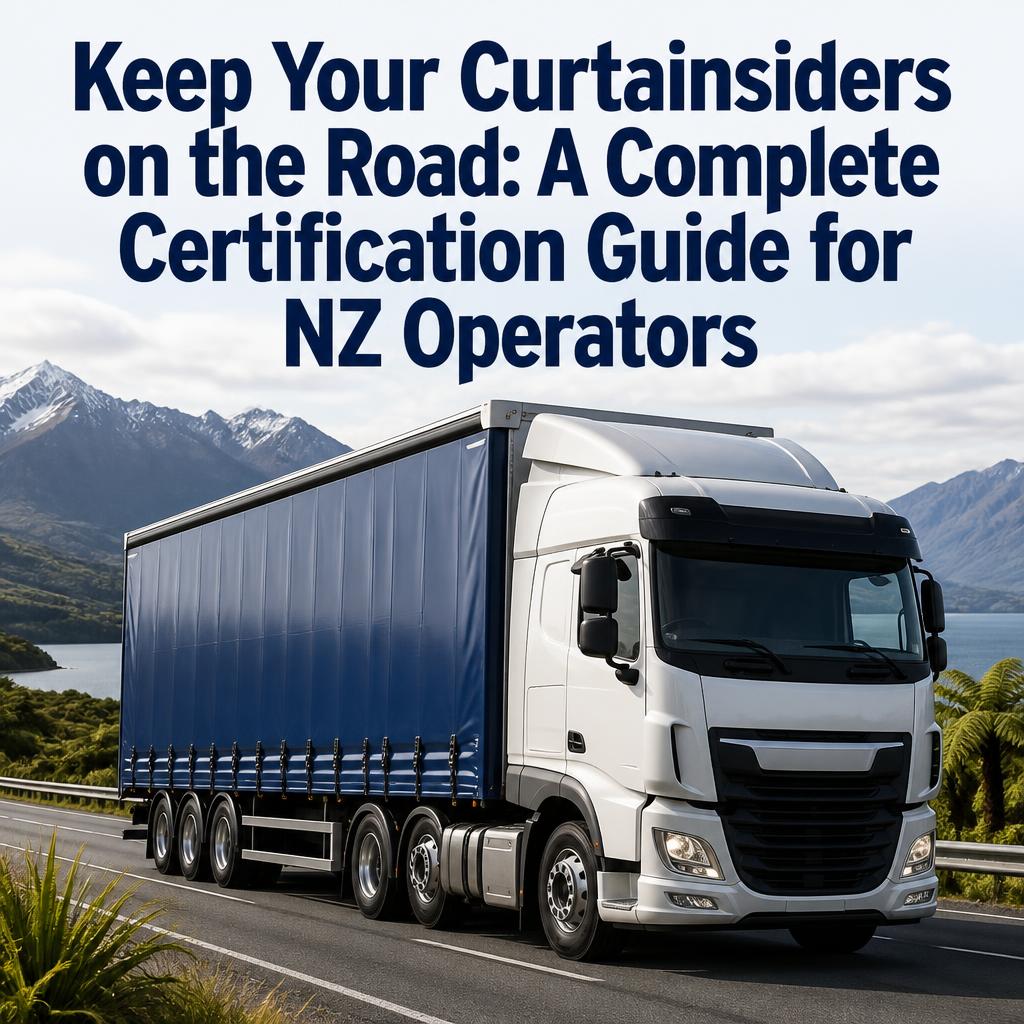
Every certified curtainside vehicle earns you uninterrupted revenue and total legal protection on New Zealand roads.
One local operator, Kiwi Cargo, lost $15,000 in fines and sat idle for three days after inspectors found a lapsed certification. That kind of hit can break a small fleet. The good news: it’s completely avoidable.
Here’s what you need to know about curtainside certification, why it matters, and how to stay compliant year-round.
What Makes a Curtainside Different?
A curtainside (or tautliner) uses flexible PVC-coated fabric walls instead of rigid steel or aluminium panels. The curtains hang from rollers on an upper track and lock down with tensioning buckles. Pull the whole side back like a drape, and forklifts can access the full deck length at once.
That speed is why 85% of side-loading freight in NZ moves on curtainsiders.
But here’s what catches new operators off guard: a certified curtain is a structural safety component, not a weather cover.
A load-rated curtain has internal webbing and high-tensile vertical straps built to resist the lateral force of shifting cargo. A standard curtain has none of that. Without the rating, your curtain offers zero legal load restraint.
| Feature | Curtainside (Tautliner) | Box Body (Rigid) |
|—|—|—|
| Loading Access | Rear and full-length side | Rear door only (usually) |
| Weight | Lighter, higher payload | Heavier, rigid protection |
| Load Restraint | Requires certified curtains/straps | Provided by rigid walls |
The fabric’s natural “give” creates real risk. If buckles corrode or UV breaks down the PVC, the vehicle can’t contain cargo through a sharp turn. That’s why NZ authorities treat curtains as critical safety equipment with strict performance limits.

The Law Behind It: Land Transport Rule Heavy Vehicles 2004
This rule is the backbone of heavy vehicle safety in New Zealand. It’s why a piece of PVC fabric gets the same legal scrutiny as your braking system.
Rule 4.5 covers body and equipment requirements. Every component bolted to the chassis must be secure and able to perform its function without risk to other road users. Your curtain system falls squarely under this rule.
Rule 4.6 addresses cargo restraint during transit. Load anchorage points must comply with NZS 5444, the standard that ensures strap-to-frame connections can handle the G-forces of emergency braking or hard cornering.
> “The Land Transport Rule is a mandatory performance standard. If a curtainside system cannot meet the load-anchorage requirements, that vehicle is a liability the moment it leaves the yard.”
> – Senior Compliance Auditor, NZ Transport Sector
Waka Kotahi (NZTA) enforces these rules across every stage of a vehicle’s life. The Certificate of Fitness (CoF) is the broad safety inspection. Curtainside certification is a specialized subset focused on the unique performance limits of flexible-walled bodies.
Regulation | Focus | Standard |
|—|—|—|
| Rule 4.5 | Body and Equipment Integrity | Heavy Vehicle 2004 Framework |
| Rule 4.6 | Load Security and Restraint | NZS 5444 (Anchorage Points) |
| CoF Oversight | General Roadworthiness | NZTA Enforcement |
One detail most operators miss: if you run outside these rules, your insurance policy may be void. You carry total personal liability for any incident.
What Inspectors Check During Certification
Auditors assess your vehicle as a specialized load restraint system. They go well beyond the standard roadworthiness check.
Curtain load rating is the first thing they verify. NZ curtains are typically engineered to provide side restraint for up to 0.8 times the Gross Vehicle Mass. Inspectors check the compliance plate and manufacturer documentation. Every load-rated curtain has a set lifespan; once that date passes, it’s legally just a weather cover.
Fabric and hardware condition comes next:
Dimensional limits matter too. A standard NZ curtainsider is restricted to 2.55 metres wide. If tracking hardware or tensioning poles push the vehicle past that limit, certification is denied. Even a few centimetres of curtain bulge from slack straps can fail you.
Why Vehicles Fail: The Most Common Problems
Failed inspections almost always trace back to gradual wear that operators ignored.
UV damage is the top culprit. New Zealand’s sun weakens PVC fast, making it brittle and prone to failure under pressure. Ripped or heavily abraded fabric means the curtain can no longer contain a shifting load.
Other frequent failures:
Stretched curtains from poor loading habits cause permanent damage too. When fabric loses its shape, it can’t provide the uniform pressure the Land Transport Rule requires. Stretched curtains can also push the vehicle past lateral width limits, creating an immediate road hazard.
How to Stay Compliant Year-Round
The best operators treat certification as a continuous process, not an annual scramble.
Build inspection routines into daily operations:
| Frequency | What to Check |
|—|—|
| Daily | Buckle tension, visible tears, rail clearance |
| Weekly | Strap webbing integrity, pillar locking mechanisms |
| Monthly | Rollers, track wear, internal tie-down point stability |
Train your drivers to run a curtain-specific walk-around every morning. A small tear might look cosmetic today. Under transit stress and UV exposure, it compromises the entire load-rated structure within weeks.
> “Maintaining a load-rated curtain requires more than duct tape and hope. It demands a disciplined schedule of mechanical checks and material assessments.”
> – Senior Compliance Auditor, NZ Transport Sector
Know the difference between a minor fix and a major structural repair. A small patch on a non-structural area may be fine. Any repair to load-bearing webbing or the curtain itself must be done by qualified technicians; and significant structural work may trigger mandatory re-certification before the vehicle goes back on the road.
Invest in driver training. Even the best-certified system fails if the operator doesn’t know how to tension curtains properly or use internal anchorage points. Training courses on heavy vehicle load securement pay for themselves by extending equipment life and preventing unnecessary strain on rails and pillars.
Keep detailed maintenance logs for every curtainsider. Document every repair and the credentials of the technician who did it. This proves to authorities that your fleet is managed to the standard NZ transport law demands.
The Cost of Getting It Wrong
The consequences hit fast and hard.
Fines for operating without a valid CoF range from $200 for minor issues to over $10,000 for corporate entities per occurrence. NZTA can also impound the vehicle on the spot, stranding your freight and sidelining the driver.
Insurance is where the real damage lands. 85% of heavy vehicle insurance policies require strict certification compliance to remain valid. If a curtainsider is involved in an accident while uncertified, your insurer may void the policy entirely. You absorb 100% of property damage, cleanup, and personal injury claims.
The full risk profile:
> “The real cost isn’t the fine. It’s the voided insurance claim and long-term reputation damage after a preventable load-shift accident.”
> – Senior Compliance Auditor, NZ Transport Sector
New Curtains vs. Repairing Old Ones
This decision shapes the long-term financial health of your operation.
| Option | Estimated Cost (NZD) | Typical Lifespan | Compliance Impact |
|—|—|—|—|
| Minor Patch | $100 – $400 | Short-term fix | Requires re-validation |
| Major Refurbishment | $800 – $1,200+ | 1-2 years | Risk of structural failure |
| New Load-Rated Curtain | $1,500 – $4,000 | 5-7 years | Full certification guaranteed |
Patch repairs look cheap upfront. But if a curtain needs multiple patches, cumulative labor and material costs approach the price of a brand-new certified unit.
UV exposure limits curtain lifespan to five to seven years for load-rated materials. Once the base fabric loses tensile strength, surface-level patches can’t restore the load rating. The curtain becomes a weather cover, not a restraint system.
> “Sticking a patch over a tear does not restore the load-rating. If the internal webbing is compromised, the curtain is merely a weather cover.”
> – Senior Compliance Auditor, NZ Transport Sector
If damage is small and surrounding fabric is still supple, specialists in hubs like Auckland can repair and re-certify with fast turnaround. But when the material has degraded, new load-rated curtains engineered for your vehicle’s coaming rails and roof structure are the smarter investment. You get full certification, fewer breakdowns, and years of compliant service.
Always get documentation from a certified repairer or manufacturer. It’s the only way to prove to an auditor that your load restraint system is intact.
What To Do Right Now
1. Walk your yard today. Locate the certification plate on every curtainsider and check the expiry date.
2. Flag any missing or expired plates. Contact a heavy vehicle specialist to book a formal inspection before your next CoF.
3. Gather repair records. Pull documentation for all recent curtain work and store it in each vehicle’s maintenance folder for easy access during inspections.
4. Train your drivers. Make curtain-specific walk-arounds part of the daily pre-start routine.
Proactive maintenance extends curtain life by two to three years and keeps your fleet earning revenue instead of collecting fines. Certification protects your cargo, your public, and your business.
Leave a Reply